
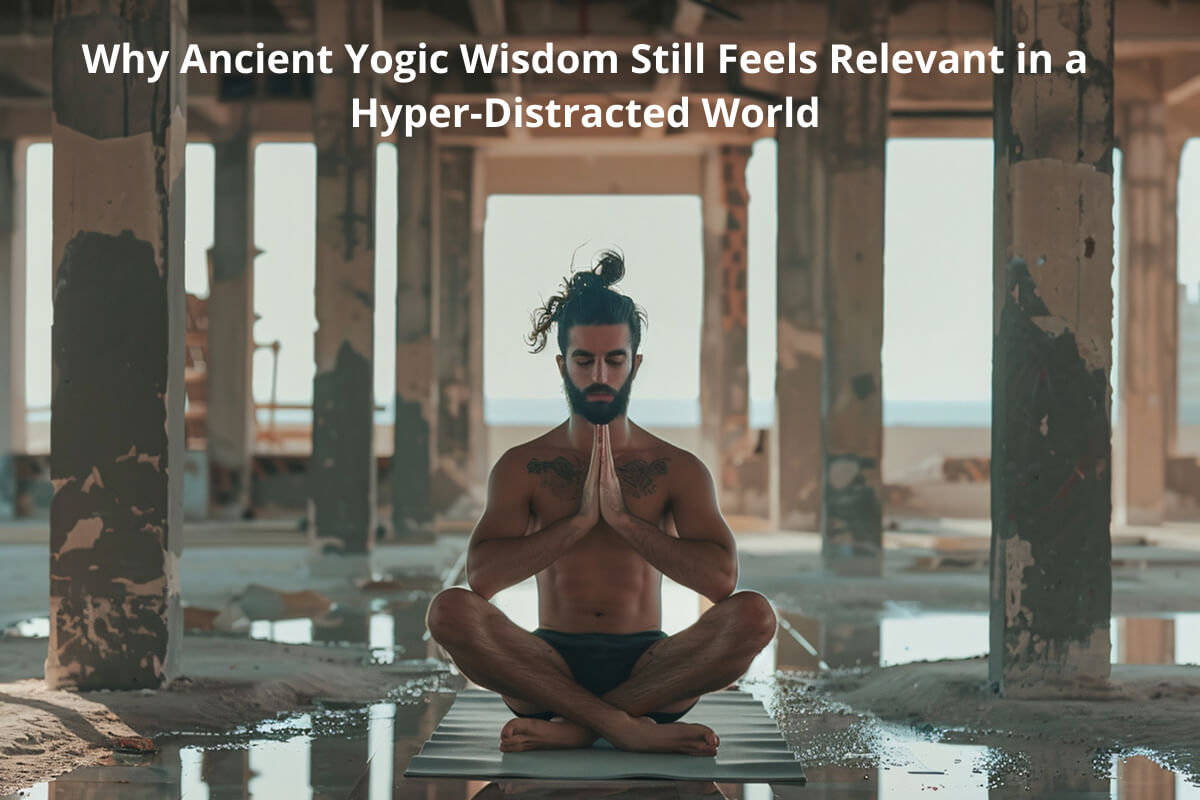
Why Ancient Yogic Wisdom Still Feels Relevant in a Hyper-Distracted World
Table of Contents
The Reality of Living in a Hyper-Distracted World
We live in a time where stillness feels unfamiliar and uninterrupted attention has become rare. Before exploring solutions or cultural insights, it is important to clearly understand the nature of the world we inhabit today.
Modern human experience is marked by constant interruptions. Notifications arrive endlessly—messages, emails, reminders, updates, alerts—each demanding immediate attention. Multitasking is no longer occasional but often treated as a skill and symbol of productivity. Yet constant task-switching fragments the mind. Instead of sustained focus, attention becomes scattered across multiple inputs, leaving us mentally exhausted yet strangely unfulfilled.
Over time, this mental fragmentation becomes normalized. We forget what it feels like to be fully present, deeply engaged, or internally settled. The mind jumps restlessly from one stimulus to another, creating a background tension that many accept as simply “how life is now.”
Why Distraction Has Become the Default State
Distraction did not arise randomly, nor is it the fault of a single device or platform. Understanding its roots requires examining how modern life functions.
Our environment is saturated with stimulation. Speed has become a defining value—faster responses, quicker results, instant feedback. In such conditions, attention becomes a valuable resource. Entire industries are built around capturing and holding it. Often referred to as the “attention economy,” human focus is continuously competed for and monetized.
However, technology alone is not responsible. It amplifies tendencies already present: the desire for novelty, validation, achievement, and control. Cultural expectations reinforce this overstimulation by equating busyness with worth and constant availability with reliability. Gradually, distraction becomes not a problem to solve but the default mental state in which we operate.
What Yogic Wisdom Was Originally Addressing
Long before digital overload, ancient traditions were deeply concerned with the restless nature of the human mind. Yogic wisdom emerged as a response to universal human challenges—mental agitation, emotional instability, dissatisfaction, and inner conflict.
Ancient practitioners observed that the mind naturally wanders, clings, resists, and reacts. These patterns created suffering regardless of external circumstances. Yogic philosophy was never about escaping the world but about understanding the mechanics of the mind. It addressed the root causes of inner instability and offered practical methods to cultivate clarity, steadiness, and freedom from compulsive mental habits.
Yoga Beyond Postures and Fitness
In contemporary culture, yoga is often reduced to physical exercise. While postures (asanas) are beneficial, this narrow interpretation overlooks the tradition’s depth and intention.
Yoga was originally conceived as a comprehensive way of living—a framework for aligning thought, action, and awareness. Physical practices prepared the body for stillness and meditation. Ethical living, self-study, discipline, and mindful awareness were equally essential. When practiced solely as a workout, yoga’s transformative potential is limited. When embraced as a lifestyle, it becomes a guide for navigating life with clarity and balance.
Attention, Awareness & Inner Discipline
At the heart of yogic practice lies a refined understanding of attention. Yoga teaches that where attention goes, energy follows. An undisciplined mind disperses energy through constant distraction, while a trained mind becomes steady and clear.
Practices such as meditation and breath awareness cultivate sustained attention. This is not forceful control but gentle training—recognizing when the mind drifts and calmly returning it. Over time, this develops inner discipline and spacious awareness.
Why the Yogic Mind Was Trained, Not Stimulated
Modern culture often responds to discomfort with more stimulation—entertainment, noise, or consumption. Yogic wisdom takes a different path.
Instead of stimulating the mind further, yoga refines and trains it. Overstimulation leads to dependency and dullness rather than clarity. Yogic training encourages reducing unnecessary input and sitting with restlessness rather than escaping it. In doing so, practitioners discover that stillness is not emptiness, but depth.
Ancient Practices for Mental Stillness
Yogic traditions offered practical methods for cultivating mental steadiness.
- Breath awareness: Observing the natural rhythm of breath anchors attention in the present and calms the nervous system.
- Witnessing thoughts: Observing mental activity without attachment reduces identification with every passing idea.
- Simplicity and restraint: Limiting excess in speech, consumption, and possessions supports inner clarity.
Self-Regulation in Yogic Living
Yogic living emphasizes moderation and conscious choice. Discipline (tapas) is not punishment but commitment—the willingness to choose long-term well-being over short-term impulse.
Through balanced living—moderate eating, working, resting, and engaging—individuals cultivate resilience and autonomy, no longer driven solely by cravings or external pressures.
The Concept of Balance Over Productivity
Modern life often prioritizes productivity above all else. Yogic wisdom measures success differently.
Balance in yoga means harmony between effort and rest, action and reflection. Productivity may arise naturally, but inner equilibrium remains the primary aim. A balanced life honors natural rhythms rather than constantly resisting them.
Why Yogic Wisdom Speaks to Modern Anxiety
Anxiety and burnout reflect deeper imbalances that yogic teachings directly address. Practices regulating breath and attention calm the nervous system and steady the mind.
More importantly, yoga reframes the relationship with thoughts. Instead of identifying with anxious patterns, practitioners learn to observe them. This shift reduces their intensity and restores perspective.
Living with Intention in a Noisy World
Today’s noise is mental as much as auditory. Living intentionally becomes an act of clarity.
Yogic living encourages pausing before reacting, aligning actions with values, and engaging fully without being overwhelmed. Intention transforms daily life into practice by deepening awareness in ordinary moments.
What Modern Wellness Often Misses
The wellness industry frequently emphasizes techniques, routines, and outcomes while neglecting inner understanding.
Without awareness and self-inquiry, even sophisticated practices remain superficial. Yogic wisdom reminds us that transformation arises from insight, not accumulation.
Can Ancient Yogic Wisdom Fit Modern Life?
Ancient teachings remain adaptable because they address universal aspects of human experience. One need not renounce modern life to practice yoga.
The essence lies in awareness, balance, and conscious living—principles that integrate naturally into contemporary contexts.
Practical Reflections for Today’s Lifestyle
- Create brief pauses during the day to reset attention.
- Notice mental chatter instead of fueling it.
- Choose depth of focus over speed of output.
- Prioritize quality of attention over quantity of activity.
Small, consistent shifts can gradually transform daily experience.
FAQs About Yogic Wisdom in the Modern World
Q1. Is ancient yogic wisdom still relevant today?
Yes. It addresses timeless aspects of the human mind, making it deeply relevant in an age of distraction.
Q2. Do we need to renounce modern life to practice yoga?
No. Yoga emphasizes inner alignment rather than external withdrawal.
Q3. How does yogic wisdom help with distraction?
By training attention, cultivating awareness, and reducing compulsive reactivity.
Q4. Is yoga only for spiritual seekers?
No. Its principles support clarity, balance, and ethical living for anyone.
Q5. Can yogic principles improve daily life?
Yes. They enhance focus, resilience, and overall well-being.
Key Takeaways
- Distraction may feel modern, but its roots are ancient.
- Yogic wisdom addresses attention and awareness at their source.
- Inner balance is more valuable than constant productivity.
- Ancient insight offers stability and clarity in a hyper-distracted world.