
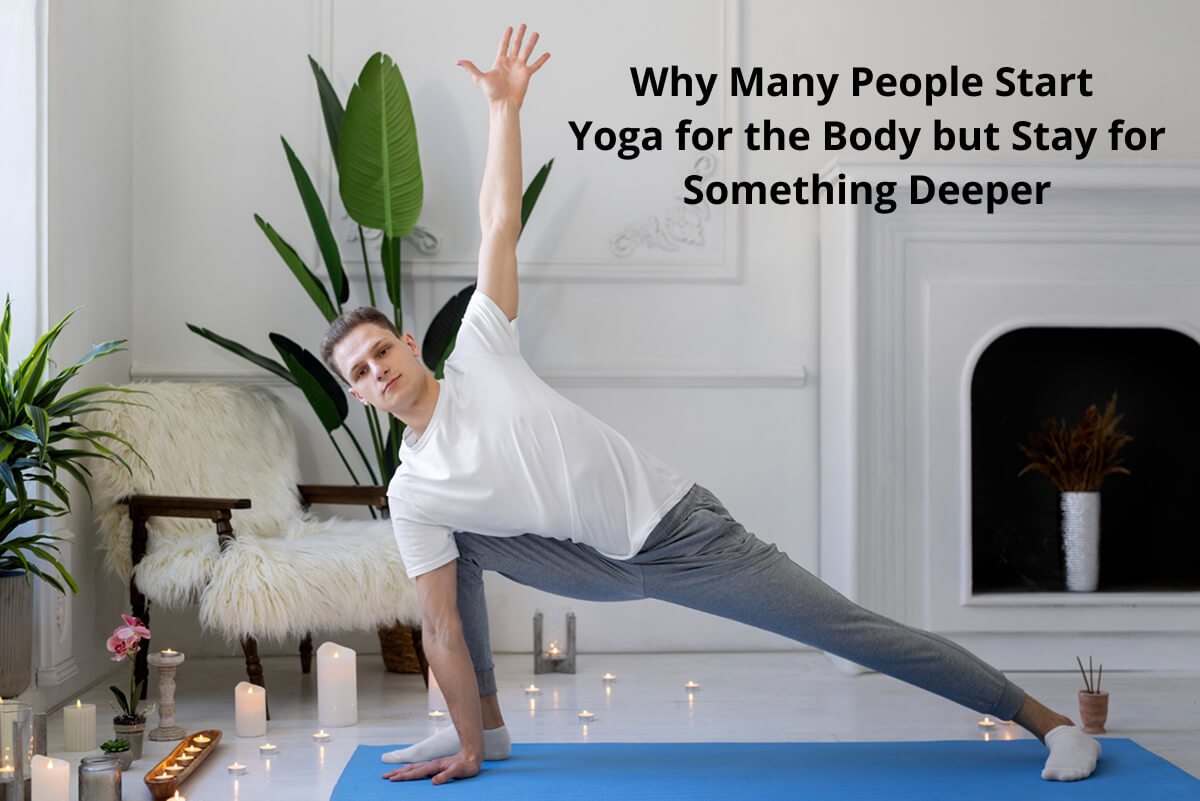
Why Many People Start Yoga for the Body but Stay for Something Deeper
Table of Contents
Why Yoga Is Often Discovered Through the Body
Yoga is often misunderstood as either a fitness routine or a purely spiritual discipline. For most people, however, it begins in a much simpler and more relatable way—it begins in the body.
A stiff back, ongoing stress, poor posture, or the subtle feeling that something feels “off” physically is usually what leads someone to unroll a mat for the first time. Rarely does a person begin yoga searching for transformation. Yet over time, many discover that yoga changes not only how they move, but how they relate to themselves and to life.
This journey—from physical motivation to deeper awareness—does not happen dramatically. It unfolds quietly, through repetition, attention, and presence.
The Physical Benefits That Attract Beginners
In the early stages, yoga’s benefits are tangible and motivating. These visible changes often encourage people to return consistently.
- Improved flexibility and strength: Muscles lengthen, joints feel freer, and movements become smoother. Strength develops in a balanced way, supporting rather than straining the body.
- Better posture and mobility: As awareness of alignment grows, habitual tension and slouching patterns begin to release. Everyday movements feel less effortful.
- Reduced physical discomfort: Chronic stiffness, lower back pain, neck tension, and tight hips often ease with regular practice.
At this stage, yoga is often evaluated by outcomes—How flexible am I becoming? How much pain has reduced? These questions are natural and helpful in the beginning.
What Happens After the Initial Phase
Once the body begins to respond, something subtle shifts.
The urgency around results softens. Attention gradually turns toward the experience of practice itself. Movements become less about achievement and more about sensation. Breathing becomes noticeable. The mind begins to slow.
There is rarely a dramatic milestone. Practitioners simply notice that presence matters more than performance. Yoga transitions from a task into an experience.
From Flexibility to Awareness
In the beginning, flexibility feels like proof of progress. Deeper folds and steadier balances become visible markers of improvement.
Over time, however, flexibility stops feeling like the point. Practitioners begin to notice that awareness can deepen even when the posture remains simple.
Movement becomes less about achieving a shape and more about listening. Sensation becomes information. The body is no longer something to conquer—it becomes something to understand.
Progress shifts from range of motion to clarity of perception.
Breath as the Bridge Between Body and Mind
Breath is often first introduced as instruction—inhale here, exhale there. At first, it feels like something to control.
Over time, breath reveals its intelligence. It reflects inner states immediately. When strain appears, breath tightens. When attention softens, breath naturally deepens.
Breath becomes less a tool and more a guide. It reconnects body and mind without force, regulating from within.
Why Yoga Feels Different from Other Fitness Practices
Yoga does not avoid effort—it reframes it.
Where many fitness practices emphasize intensity and output, yoga prioritizes quality of attention. Rest is integrated intentionally. Success is defined not by performance but by presence.
This fosters cooperation with the body rather than domination of it.
Emotional Shifts That Emerge with Practice
As physical tension releases, emotional patterns often surface. Yoga does not create emotions—it reveals what was already present.
Practitioners frequently notice reduced reactivity. A pause begins to appear between stimulus and response.
Emotions are experienced without urgency. They are felt, not suppressed—and allowed to pass.
The Role of Stillness in a Movement-Based Practice
Stillness in yoga is not inactivity—it is integration.
Pauses between postures allow sensation to settle and awareness to deepen. Rest becomes part of the practice, not a reward for effort.
This understanding gradually reshapes how rest is perceived in daily life.
Why People Begin to “Feel” Yoga Beyond the Mat
Eventually, yoga does not end when the practice ends.
Tension is noticed earlier. Breath becomes a steady reference during stress. Conversations feel less reactive. Decisions feel more grounded.
Yoga integrates into life not as a technique, but as a way of relating.
Yoga as a Mirror, Not a Method
Yoga reflects habits rather than correcting them.
Impatience, comparison, resistance, and self-judgment all appear clearly during practice. The mat becomes a mirror—not offering criticism, but clarity.
Awareness creates the possibility of change without force.
Letting Go of Performance and Perfection
As awareness deepens, the need to perform fades.
Comparison weakens. Curiosity replaces evaluation. Questions shift from “Am I doing this right?” to “What am I noticing?”
Yoga becomes exploration rather than improvement.
How Regular Practice Changes Perspective
- Challenges feel less personal: Difficulty is experienced as part of fluctuation, not failure.
- Setbacks feel temporary: Limitations are seen as passing states.
- Identity becomes flexible: Attachment to fixed self-images softens.
- Response replaces reaction: Awareness creates space for choice.
- Experience feels fluid: Change becomes less threatening.
- Life feels participatory: Engagement replaces opposition.
Why People Stay Even When Body Goals Are Met
- Inner steadiness: Emotional balance becomes less dependent on circumstances.
- Grounding: Attention returns naturally to breath and sensation.
- Deeper self-connection: Self-awareness replaces self-judgment.
- Shift from doing to being: Practice becomes relational rather than goal-driven.
FAQs About Yoga’s Deeper Impact
Is yoga only about physical fitness?
No. Physical benefits may initiate practice, but long-term impact lies in awareness and emotional balance.
When do deeper benefits appear?
After consistency is established. They unfold gradually and are often recognized in hindsight.
Can yoga help beyond stress relief?
Yes. It reshapes how emotions, uncertainty, and relationships are experienced.
Do I need spiritual beliefs?
No. Awareness develops through participation and attention, not belief.
Why does yoga feel different over time?
Because awareness becomes central. Outcomes fade; presence deepens.
Key Takeaways
Yoga often begins as a practical response to physical discomfort, but it rarely remains limited to the body.
With regular practice, awareness gradually becomes central. Breath, sensation, and presence matter more than performance.
Eventually, yoga extends beyond the mat—shaping how challenges are met, how emotions are held, and how life is experienced.
What begins as movement often becomes a way of relating—grounded, attentive, and responsive.