
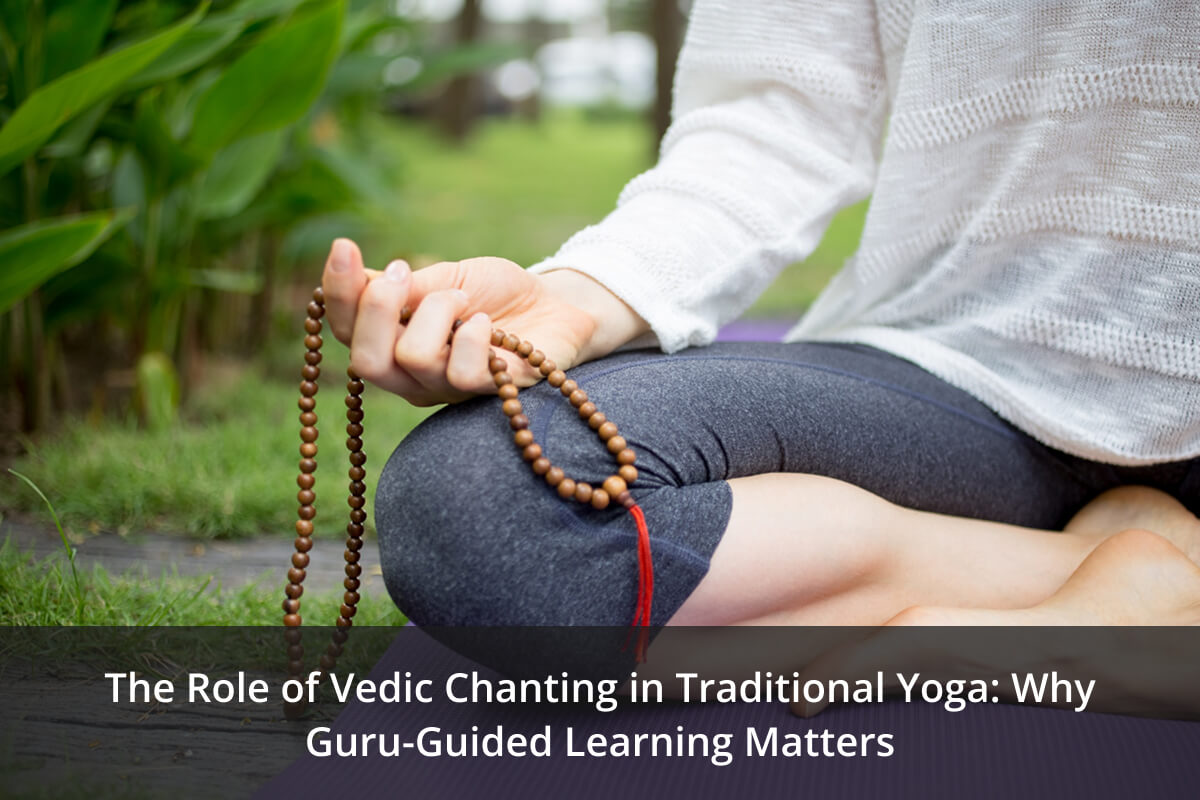
The Role of Vedic Chanting in Traditional Yoga: Why Guru-Guided Learning Matters
Table of Contents
For centuries, Vedic chanting has been kept alive through careful listening, disciplined repetition, and direct help from teacher to student. Long before books ever carried these sounds they were kept in memory, spoken at dawn , repeated beside sacred fires, and passed from one breath to the next with an almost eerie precision.
Traditional yoga was never only about the physical poses, not even close. Chanting and breath awareness , meditation and self-study were tied together in a very natural way, each one supporting a calmer, more alert inner life. In this older view of yoga, sound wasn’t some extra ornament, it was the actual practice itself.
So Vedic chanting sits right at that meeting point of discipline and stillness. The voice follows a pattern, the breath finds balance, and the mind slowly learns how to stay right here, present. Every syllable sort of asks for attention, that’s why chanting has been valued for generations not only as a spiritual tradition, but also as a method for building focus and quiet awareness inside.
At the center there is the Guru–Shishya Parampara, a teacher-student lineage that helped hold the chants in their original shape across many years and many people. Through listening, small corrections , and repetition the whole thing stayed alive not as theory , but as something you actually live with, carried forward by the human voice.
What Is Vedic Chanting in Traditional Yoga?
Before Vedic chanting turned into something people studied, it was mostly something people did, like, day to day. It kind of moved from teacher to student through memory , breath, and repeating again and again. Not only the verses mattered, but also the way you pay attention to sound itself. In traditional yoga, chanting wasn’t really a separate thing from discipline, awareness, or that inner steadiness people work on.
Definition of Vedic Chanting
Vedic Chanting is basically the older practice of saying Vedic mantras with a really exact pronunciation, rhythm, and tonal flow. For ages, these chants stayed alive because people passed them by spoken transmission , and honestly even the slightest shift in sound was seen as something that matters quite a lot.
Why Chanting Holds Importance in Yogic Traditions
In yogic traditions, chanting is used as a tool to calm the mind, and to move deeper into focus. By repeating a sound you create a kind of pulse with the breath, and it helps attention stay planted in the now moment. Also it builds discipline. you end up learning how to listen well, how to pronounce each syllable cleanly, and how to stay fully there while you recite, instead of doing it on autopilot or like it’s just routine.
The Difference Between Vedic Chanting and Devotional Singing
Vedic chanting uses a fixed design of tones, short pauses, and pronunciation that gets passed down through lineage. It’s recited with precision, where the sound patterns hold just as much importance as the words themselves. Devotional singing, however, tends to be more expressive and music-like. It’s usually guided by feeling and melody, while Vedic chanting stays rooted in accuracy, memorization, and oral discipline.
The Relationship Between Mantra, Breath & Attention
In Vedic chanting, the breath kind of automatically ends up matching the cadence of the mantra. That steady stream of sound kinda nudges slower breathing and it also helps the mind get quieter, more alert When attention stays right on each syllable plus the small pauses in between, chanting turns less into a “show” and more into being there. The voice breath , and mind start moving as if they share one rhythm, the same way
The Connection Between Yoga, Breath & Sacred Sound
Before yoga turned into a posture thing, it was more or less heard as much as it was felt. Breath, mantra, and silence never really were separate stuff. The body moved, the lungs just followed, and then sound carried the attention inward, like quietly pulling it closer. In a lot of traditions, sacred sound was treated like a sort of bridge, not loud, not overly dramatic, just steady enough so your focus could return when the mind wanders off ,again.
Understanding Nada (Sacred Sound) in Yoga
Nada is often described as inner sound, the subtle vibration under regular noise. In yogic traditions they said that listening deeply could calm the constant chatter in the head. Sometimes the soft repeating of a mantra feels less like “talking” and more like remembering something ancient, parked inside you.
How Sound Influences Breath Regulation
Chanting tends to slow the breath down. A long mantra can stretch the exhale without forcing it, and the breathing ends up more even, less edgy, more settled. That’s also why a simple sound like “Om” can help. The breath starts to move in a kind of rhythm, instead of rushing ahead of itself.
The Role of Chanting in Building Mental Focus
The mind gets distracted very fast ,especially when you’re trying to be still. Chanting gives attention a place to land, one syllable at a time. Instead of battling thoughts, the sound just nudges awareness back, gently. Over time, the focus feels less like strain and more like it’s just happening naturally.
Why Traditional Yoga Included Sound-Based Practices
Traditional yoga was never only about motion. It kind of mixed posture, breath, sound, and awareness together into one practice, or at least that’s how it was taught. Chanting helped people feel more linked, not just to the body, but to something larger and also more settled, inside themselves.
Why Vedic Chanting Has Traditionally Been Learned Through a Guru
Before Vedic chanting was ever written down in books, it kind of stayed in that in-between space between one voice and another. A student didn’t just “study” the chant, he was near it, listened daily and little by little let the sound sink into breath and memory. That nearness is probably why the guru tradition became so tied up with Vedic learning, you can’t really pull one away from the other.
Importance of Direct Oral Instruction
Vedic chanting was learned by listening first, not by reading. The student would sit while the guru recited the line again and again, until the sound became natural in the tongue and also in the breath. The guru also kept an eye on the student while chanting back. Even a slight pause, a wobble in confidence, or a small shift in sound was corrected right away. So the chant stayed steady across generations, without drifting.
Correcting Pronunciation and Intonation
In Vedic chanting, changing just one tonal piece can move the balance of the verse. A guru supports the student in noticing fine differences that books alone do not always explain fully. Most of the guidance feels subtle, like a lifted note, a calmer glide, or a longer breath held in the right place. Over time, the student understands that pronunciation isn’t just decoration , it carries meaning.
Why Rhythm and Tone Matter in Chanting
A Vedic chant travels with a fixed rhythm, almost like remembered footsteps in the body. The way the tone rises and settles gives the practice a kind of strictness that helps the chant stay in its original form. Students are trained to follow that pattern with patience, and steadiness too. This work is less about showing off, and more about remaining aligned, with the tradition itself.
Learning Beyond Words and Memorization
A teacher shows more than a list of sounds. With repetition, and that quiet space between phrases, the learner gradually builds attention, self control, and the skill to stay entirely here. After years of chanting, the teaching starts feeling less loud and more grounded. The mind stops hurrying, and even listening like actually listening turns into a kind of routine practice.
Understanding Guru-Shishya Parampara in Yogic Learning
Before the guru was even a title, he was sort of a voice in the dark . A student sat there by the fire, not really with notebooks ,but with a kind of attention, steady and quiet. Learning started when listening got deep enough that the words didn’t just stay in the head, they slipped into the body as well, slowly ,almost without asking permission.
Meaning of Guru-Shishya Parampara
Guru-Shishya Parampara was never only about dumping facts onto someone. It felt more like a living tether, where wisdom traveled from one human to the next , bit by bit, through trust, being there, and everyday repetition. The guru didn’t just hand out information. He worked on the student’s whole way of looking, breathing, speaking,and carrying life forward, until knowing became part of the person, not only a thing remembered for later.
How Knowledge Was Preserved Through Oral Learning
Before books were common, learning had to survive by sound and repetition. Students listened with care ,and then repeated every line aloud, taking the teachings in memory for years, like they were holding something warm. In that way, the voice turned into scripture. One single verse was said again and again until rhythm, breath, and meaning settled in a natural manner ,right into the body.
The Role of Discipline and Humility in Learning
Traditional learning required patience more than speed. Students woke up early, practiced daily, and learned that insight arrives bit by bit ,mostly through consistency not quick tricks. Humility was not an extra, it was the practice itself. Even the act of bowing trained the student to unclench pride , leaving room, so deeper understanding could enter quietly. And it did, almost like it was respectful.
Why Traditional Learning Focused on Direct Experience
In yogic paths, knowledge wasn’t treated as finished until it was lived. A student had to meet stillness, breath, silence, and discipline directly from the inside. Not in theory, not as an idea, but as real experience, right there in the self.
The Importance of Pronunciation, Rhythm & Listening in Chanting
Vedic chanting is learned slowly , kinda like learning to breathe in a new way. It is not only about saying the words correctly, it is more about letting the sound settle,into body and mind, almost like it finds a home.
Each chant has some kind of movement, a pulse that keeps asking for attention. The more carefully a person listens , and repeats, the more the chant starts to shape inner quietness without rushing it.
Why Pronunciation Is Central in Vedic Chanting
In Vedic chanting, even a tiny change in sound can shift the meaning, completely. A syllable spoken with care keeps the chant alive in the very same form it was heard centuries ago. The focus on pronunciation is not just about strictness. It is more like respect for the lineage, where each tone and pause holds memory, discipline, and intention ,all together.
Understanding Rhythm and Tonal Patterns
The rhythm of chanting follows the natural movement of breath. When breath and sound move together, the chant feels less pushed, more like a smooth current. The rise and fall of tones brings a kind of inner balance. Slowly, the body starts to remember the pattern, before the words fully land in memory.
Listening as an Essential Learning Skill
Before repeating a chant, students first learn to listen with depth. The ear is trained patiently, because real chanting begins with hearing, not speaking. Period. Careful listening catches subtle pauses, tonal shifts, and breath movements, things that you can’t always understand from written text only, so it really has to be felt.
How Chanting Builds Concentration Through Repetition
Repeating the same chant again and again gently gathers the scattered mind. The rhythm gives attention a place to rest, without force, or so it seems. Over time, chanting creates a quiet kind of steadiness.
How Vedic Chanting Supports Focus, Breath & Inner Awareness
Before the chant settles into silence , something else starts to happen, kind of quietly, inside the body. The breath slows down. Thoughts stop running in every direction. That sound gives the mind something steady to come back to , again and again, like it knows the way home. In Vedic chanting, focus isn’t forced. It seems to arrive slowly through repetition, rhythm , and a kind of attention that stays gentle
Synchronizing Breath with Chanting
Each mantra moves with breath. The longer syllables stretch the exhale , while pauses train the body not to hurry. Slowly, breathing stops feeling mechanical and starts feeling mindful. The chanter begins noticing how sound and breath lean on one another. A steady chant can create a steady mind without needing to tug or control it.
Developing Mental Clarity Through Repetition
Repetition in Vedic chanting isn’t a empty routine. Saying the same mantra again and again kind of clears mental clutter, like water settling after being stirred. With time, the mind jumps between thoughts less often. Attention becomes quieter, sharper , and more grounded in the present moment, not just “somewhere else”.
Chanting and Nervous System Relaxation
The measured pace of chanting naturally eases tension in the body. The voice, breath, and heartbeat gradually start moving in the same rhythm, kind of like they agree on a shared tempo. Even a few minutes of chanting can bring a sense of inner stillness. Not because the problems disappear, but because the body stops reacting to everything all at once, so everything can settle , too.
Supporting Meditative Awareness in Yoga Practice
Vedic chanting helps your mind get ready for meditation in a way thats kind of simple, and very focused, like it gives you one point to hold. The sound becomes a doorway into quiet, not a distraction from it . In yoga practice, chanting also keeps attention inside the body
Traditional Oral Learning and the Preservation of Vedic Knowledge
Long before there were books, pages, and all that printed stuff, knowledge basically lived in the human voice. In the Vedic world, memory was not merely a skill,it was devotion discipline and responsibility, passed along from one generation to the next like something you hold with both hands.
Why Ancient Traditions Relied on Oral Transmission
The Vedas were treated as sacred sound before they ever became written words. Teachers felt that the vibration, and the exact pronunciation, carried the real core of what was taught, not only the literal meaning sitting in the background.
Memorization and Repetition in Vedic Learning
Vedic students practiced through kind of constant recurrence, sometimes chanting the same verse, hundreds of times, until it kind of settled into breath and memory on its own. Over time the body itself, started to keep the rhythm and tone, as if by quiet habit rather than effort.
Maintaining Accuracy Across Generations
Even tiny changes in tone, or pronunciation were treated as important. Careful repetition helped the chants remain close to what people had heard long ago, even across centuries. Because of that, different recitation patterns and teaching methods were developed, not just for variation, but to block small errors. That exactness is what let the tradition move forward across generations without losing its earlier form.
Chanting as a Living Tradition Rather Than Theory
Vedic chanting was never meant to sit only as scripture or, uh, philosophy. It was intended to be spoken out loud, practiced, every day, and really felt through sound and breath. Even now, chanting keeps happening in homes, temples, and in learning spaces too. It stays alive by human voices not by silent pages, and somehow the whole thing just carries on.
Challenges of Learning Vedic Chanting Without Proper Guidance
Learning Vedic chanting without a teacher can feel kinda simple at first. The words are everywhere now in books , apps , recordings but the living pulse of the chant is harder to catch on your own. What looks like repetition from the outside is actually a discipline, of breath tone memory, and attention all together.
Mispronunciation and Incorrect Rhythm
A slight change in tone can shift the whole flow of a mantra. In Vedic chanting sound is not just decoration it is the framework. When the rhythm slips, the chant starts losing its own natural breath, and balance too. A lot of learners copy recordings without realizing where the voice should climb, pause, or glide. The words might sound right, but the chant feels tense, instead of waking up and feeling alive.
Lack of Understanding of Meaning and Context
Chanting gets deeper when the sense behind the words is actually known. Without context, sacred lines can start to feel far away, like memorized sounds with no real link. When you know even a bit like the deity, the intention, or where it sits in ritual the practice has more warmth. The voice carries more sincerity because the heart understands what it is saying, not just the syllables.
Mechanical Repetition Without Awareness
It is easy to fall into counting instead of listening. Your mouth keeps moving, but the mind goes elsewhere, and the chant becomes routine without presence. Traditional teachers often interrupt students a little, to correct pronunciation as well as attention itself. A mantra is meant to be heard from within, not only repeated out loud, like a script.
Difficulty Maintaining Consistency and Discipline
Vedic chanting sort of asks for patience, not speed. In the start a lot of people practice pretty hard for just a couple days , and then slowly they drift away from it, like… without noticing. The tradition is kinda built on daily repetition small steady work that continues year after year. Even a few mindful minutes every morning can keep the thread intact better than those occasional long periods, when you suddenly try to do everything at once
Traditional vs Modern Approaches to Learning Chanting
Vedic chanting once stayed only in the gurukul— voice to voice, breath to breath. Today the same sounds slide through headphones , video calls, and online recordings , landing in places far away from temples and teachers.
In-Person Learning Versus Digital Resources
Learning face to face has a different kind of quiet. A teacher catches tiny changes in breath or tone, correcting the chant and also the posture, and that steady presence behind it. Digital resources though, have opened pathways for people who may never sit in a traditional gurukul. A recording can be replayed endlessly, so practice keeps going even after the lesson, kind of slips away.
Accessibility of Online Chanting Education
Online chanting education has made Vedic learning reachable across cities, countries, and generations. Someone in a small apartment can now learn chants that once were limited to particular lineages, and certain spaces. For working adults and elders especially, this flexibility means a lot. Learning can happen slowly, at your own rhythm, without that constant pressure of matching a physical classroom.
Advantages of Traditional Guided Learning
Traditional teaching offers more than pronunciation. A student absorbs discipline, the gentle pauses, ritual, and that quiet respect that wraps around the chant itself. Also there is this continuity, when you hear the mantra directly from a living teacher. The sound starts to feel less like information ,and more like inheritance, carried forward.
Balancing Authenticity with Modern Convenience
Modern tools can make learning more simple, but chanting still asks for patience and careful listening, you know, like for real. Convenience helps a lot, but it can’t quite swap out the depth of guided oral tradition, not entirely.
Beginner-Friendly Ways to Start Learning Vedic Chanting
Vedic chanting can feel ancient and kind of far away at first, but it starts in a very basic way — with listening, breath , and repetition. Nobody comes in with perfect pronunciation right from the start, even the oldest traditions were learned one sound, at a time.
Start with Simple Sanskrit Sounds or Short Mantras
Go gentle at first with something small like “Om” , “Gayatri Mantra” , or “Shanti.” Short sounds help the tongue get used to Sanskrit without it feeling too heavy. At the beginning the goal is not speed ,and it’s not perfection either. It’s figuring out how each syllable sits in the mouth, and how breath moves through it as you go.
Practice Listening Before Repeating
In Vedic chanting, listening comes before speaking. Hearing the rise, and the fall of the tone carefully teaches the ear more deeply than just reading the words from a page. Sometimes the chant “clicks” into the body after many quiet listens. The rhythm arrives slowly, almost like you’re remembering something you forgot.
Learn Slowly with Attention to Breath and Rhythm
Every chant has its own tempo, and its own pulse. Rushing through the lines can flatten the sound, and then the whole thing starts to feel mechanical. A calm breath naturally supports the rhythm. With time the body starts to flow along with the chant, not fighting it.
Develop a Consistent Daily Practice
Even five or ten minutes in the morning can build familiarity with the sounds. Vedic chanting grows more from repetition than from intensity. Some days the voice feels clear, and some days you drift off. The practice keeps going because you return again, not because you nailed everything flawlessly every time.
Seek Guidance from Experienced Teachers
A teacher fixes little tonal issues that most books seem unable to fully explain. In Vedic chanting sound is carried from one person to another, in a kind of direct way. Studying with someone experienced also builds confidence, and honestly you get calmer faster. Then you start to grasp not just how to chant properly, but also how to listen with careful attention.
Common Misconceptions About Vedic Chanting
People often approach Vedic chanting with modern assumptions, you know, like it should be fast, maybe performative and also something mostly locked up in ritual alone. But this tradition was never really designed that way. It lives in breath, memory , and discipline — kinda quietly, but steadily.
“Vedic Chanting Is Only Religious”
Many think Vedic chanting belongs only inside temples or rituals. However, for centuries, it has also been a practice of remembering, breathing , focus, and discipline, woven into day to day life. Even when someone doesn’t understand every Sanskrit term, they still can feel the steadiness that the sound creates. The chant works first through vibration, then through meaning.
“Pronunciation Is Not Important”
In Vedic chanting, pronunciation is everything. A single shift in tone can change the rhythm and the intention of the mantra, completely. That’s why students spend years repeating the same verses aloud. The sound is handled with care, almost like keeping a flame from getting snuffed by wind.
“Anyone Can Master Chanting Quickly”
Vedic chanting is slow, not something you just pick up overnight. The body has to learn the breath before the mind learns the verse. From a distance a chant can sound simple. But real practice asks for patience, listening, repetition and years of correction from a teacher.
“Vedic Chanting and Singing Are the Same”
Vedic chanting is not done like music, at least not in the usual sense. It follows fixed tonal motions rather than melody or personal expression. A singer may dress a note with style, but a Vedic chanter protects it. The goal isn’t display, it’s preservation, plain and simple.
FAQs
Vedic chanting keeps going because it travels from voice to voice, not page to page, and kinda somehow it still works. Even today, lots of learners start by listening before they really understand, so the sound slowly , shapes both the breath and the mind. These questions come up especially for beginners stepping into the tradition for the first time. The answers are simple, human, and pulled from real practice more than from theory.
Why is guru-guided learning important in Vedic chanting?
A guru does more than teach pronunciation. They show where the breath turns, where the tone lifts up, and where silence has to stay untouched, even when it feels awkward. Those little places can’t fully fit inside books.
Can beginners learn Vedic chanting?
Yes, gently and patiently. Most people begin with short mantras, basic svaras, and repeated listening before they chant confidently on their own. Vedic chanting is less about gift or talent and more about steadiness. The voice learns the way hands learn prayer — through repetition, not some flashy perfection.
Is Vedic chanting part of traditional yoga practice?
Traditionally, yes. In many older yoga paths, sound was seen as important as posture and breath, and they treated it like a key not just background noise. Chanting prepared the mind first, before meditation really began. The vibration of mantra was believed to calm inner motion. Even today, many yoga traditions start practice with chanting, to build focus, and presence too.
How does chanting improve focus and breath awareness?
Chanting, naturally slows the breath, because every syllable is kinda asking for your attention, you know. The mind can’t really drift as easily when the sound rhythm and the breathing are moving together, sort of in a single current. After a while, people often notice they pull air more deeply, and they start listening more carefully too, even if at first it feels a little messy, like you’re still working out the groove.
Do I need to understand Sanskrit before learning chanting?
No you don’t really need to understand Sanskrit before you start learning chanting . Traditionally a lot of students begin with listening and repeating, like, way before they understand every single word. For them the sound arrives first, and meaning follows after, kind of in a slow, gradual way.
Final Thoughts
Vedic chanting has survived not because it was written down, but because people kept saying it aloud—through homes, temples, forests, and several generations. Even now its strength is still there in that basic act of sitting quiet and giving full focus to what you hear, and not just what you “think” you hear. You don’t need a perfect voice or a full knowledge of everything to start, it. What matters is that you are ready to listen, breathe slowly , and come back to the chant again and again. Through this repeating, something old, stays awake and keeps moving forward.