
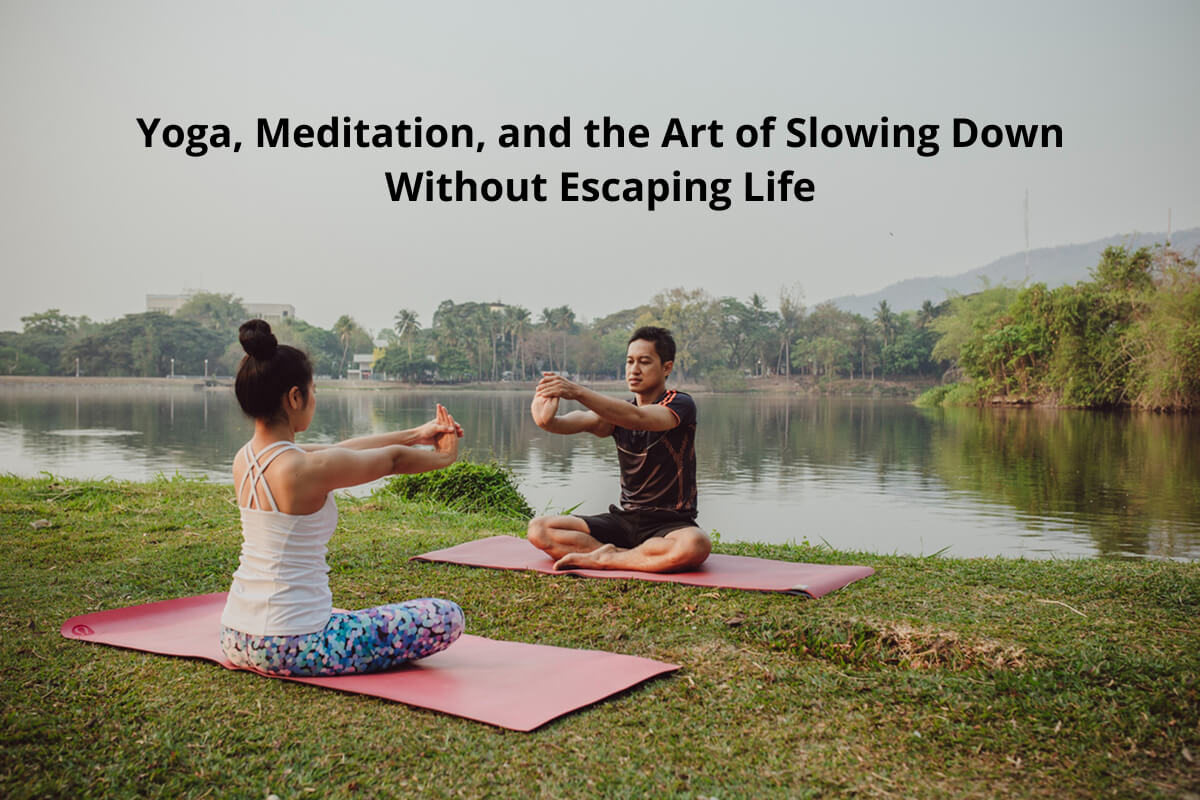
Yoga, Meditation, and the Art of Slowing Down Without Escaping Life
Table of Contents
Why Slowing Down Feels Difficult Today
Slowing down is often spoken about as a choice—something we should do for balance or well-being. Yet for many people, the idea of slowing down does not feel calming; it feels unsettling, even threatening. This discomfort is not a personal failure. It is a natural response to the world we live in.
Modern life is built on speed. From an early age, we receive signals that urgency equals importance. Notifications demand immediate attention. Deadlines compress time. Success is measured by productivity, visibility, and how much can be accomplished in the shortest span.
Busyness has become a form of social currency. Saying “I’m overwhelmed” is often worn as a badge of honor, while having space in one’s schedule can feel difficult to justify. Rest feels like something that must be earned.
Technology intensifies this pace. We are not only completing tasks—we are constantly accessible. Even during moments of pause, the mind remains in motion. In such conditions, slowing down feels like resistance.
Without constant movement, unresolved thoughts, emotions, and fatigue surface. This can feel uncomfortable, which is why many people instinctively avoid slowing down—not because they do not want peace, but because speed has become their coping strategy.
The Misconception: Slowing Down Equals Escaping Life
Because speed is closely associated with responsibility and ambition, slowing down is often misunderstood as disengagement. Many assume that to slow down means to become less capable, less driven, or less relevant.
In fast-paced cultures, rest can be mistaken for laziness. There is a fear that reducing pace means falling behind. Yet this assumption ignores a deeper truth: constant rushing often reduces quality.
True slowing down is not withdrawal—it is recalibration. It sharpens attention and aligns action with intention. When pace eases, decisions become more deliberate. Engagement becomes clearer, not weaker.
Slowing down does not remove responsibility. It refines it.
What Yoga and Meditation Were Truly Meant For
Yoga and meditation are often introduced today as stress-relief tools or wellness add-ons. While they can reduce stress, their purpose runs deeper.
At their core, these practices cultivate clarity and balance. Yoga aligns body and breath so attention can settle. Meditation trains the mind to observe without being overwhelmed.
They were never meant to remove individuals from life. Instead, they prepare individuals to engage more skillfully—with steadiness rather than reactivity.
Slowing Down as Awareness, Not Withdrawal
Slowing down is not stepping away from life’s demands—it is shifting how those demands are met.
When pace slows internally, awareness expands. Actions become conscious rather than automatic. There is space between stimulus and response.
Life continues fully. What changes is the level of friction. Engagement becomes intentional rather than impulsive.
Yoga: Staying Present in Action
Yoga is not about stopping movement—it is about moving with awareness.
Each posture becomes an opportunity to notice sensation, effort, and breath in real time. Movement transforms from command to conversation.
Breath anchors attention. When effort turns into strain, breath tightens. When awareness steadies, breath softens. This feedback teaches regulation without withdrawal.
Over time, presence cultivated in movement carries into daily life. Action no longer requires disconnection.
Meditation: Meeting the Mind as It Is
Meditation is not about silencing thought. It is about observing thought.
Rather than controlling experience, meditation invites awareness of whatever arises—pleasant or uncomfortable. Familiarity develops. Patterns become visible.
This non-avoidance reduces fear. Thoughts lose their authority. Emotions are felt without overwhelming identity.
Meditation deepens engagement with life by beginning from within.
Why Escapism Looks Attractive in a Fast World
When life moves relentlessly, escapism can feel like relief. Overwhelm accumulates, and the nervous system seeks rest.
Distraction promises quick comfort—without reflection. Whether through endless scrolling, entertainment, or avoidance, escapism temporarily softens intensity.
Yet relief gained without awareness is short-lived. The underlying strain often remains.
The Difference Between Rest and Avoidance
Rest restores. Avoidance postpones.
Healthy rest is intentional. It recognizes fatigue and renews capacity. After true rest, engagement with life strengthens.
Avoidance, by contrast, disconnects from responsibility without replenishing energy. It may distract temporarily, but often leaves lingering stress.
The difference lies in awareness. Rest is conscious; avoidance is reactive.
Living Slowly While Remaining Fully Engaged
Living slowly does not mean doing less. It means engaging differently.
With focused attention, tasks are completed more precisely. Conversations become more meaningful. Energy is gathered rather than scattered.
Slowness enhances capacity rather than diminishing it.
How Slowing Down Improves Decision-Making
Hasty decisions often arise from fear or pressure. Slowing down interrupts this reflex.
When mental noise settles, options can be evaluated clearly. Emotional signals are acknowledged without dominating choice.
The pause between impulse and action improves judgment and builds trust in one’s discernment.
Slowing Down in Work, Relationships & Daily Life
- At work: Listening improves. Focus sharpens. Errors decrease.
- In relationships: Reactions soften. Empathy increases.
- In daily routines: Brief pauses reset attention and reduce accumulated stress.
These subtle shifts transform the texture of life without reducing engagement.
Inner Stillness vs External Silence
External quiet is not required for inner calm.
Inner stillness is a quality of attention—remaining steady amid activity. It does not depend on controlling the environment.
With practice, calm can coexist with noise, deadlines, and movement.
Why Balance Matters More Than Speed
Speed without balance becomes strain. Balance supports sustainability.
When rhythms of effort and rest are honored, resilience increases. Productivity becomes enduring rather than exhausting.
Balance is not the opposite of ambition—it is what sustains it.
Practical Ways to Slow Down Without Quitting Life
- Conscious breathing: Take a few deliberate breaths before transitions.
- Single-tasking: Focus fully on one activity at a time.
- Brief pauses: Integrate short moments of stillness throughout the day.
These small shifts create internal space without reducing external engagement.
FAQs About Slowing Down with Yoga & Meditation
Does slowing down mean doing less?
No. It changes how activity is approached, not the amount of activity itself.
Can busy people benefit?
Yes. Even brief, consistent moments of awareness can increase resilience and clarity.
Is slowing down detachment?
No. It strengthens engagement by reducing impulsive reactivity.
Will productivity decrease?
Often the opposite occurs. Focus improves and energy is conserved.
Can calm exist in busy environments?
Yes. Inner steadiness develops through awareness, not external silence.
Key Takeaways
Slowing down is not escape—it is conscious engagement.
Yoga and meditation cultivate awareness within action, not withdrawal from it.
Presence strengthens clarity, resilience, and sustainable effort.
True slowness is an inner quality that allows life to be lived with depth and intention—even in motion.